California New Car Dealers Association Releases Q4 2025 Auto Outlook
Contact: Autumn Heacox, Director of Communications & Marketing: aheacox@cncda.org, (916) 441-2599 x105
Q4 2025 CA Auto Outlook: ZEV Registrations Fall for the First Time Since 2020
Overall New Vehicle Sales Finish 2025 on a High Note
Click on the image to view the report.
SACRAMENTO, CA (January 22, 2026)—Today, the California New Car Dealers Association (CNCDA) released its Q4 2025 California Auto Outlook report, providing a full-year analysis of statewide new vehicle registration trends. All data in the report is sourced from Experian Automotive and must be cited when referencing these findings.
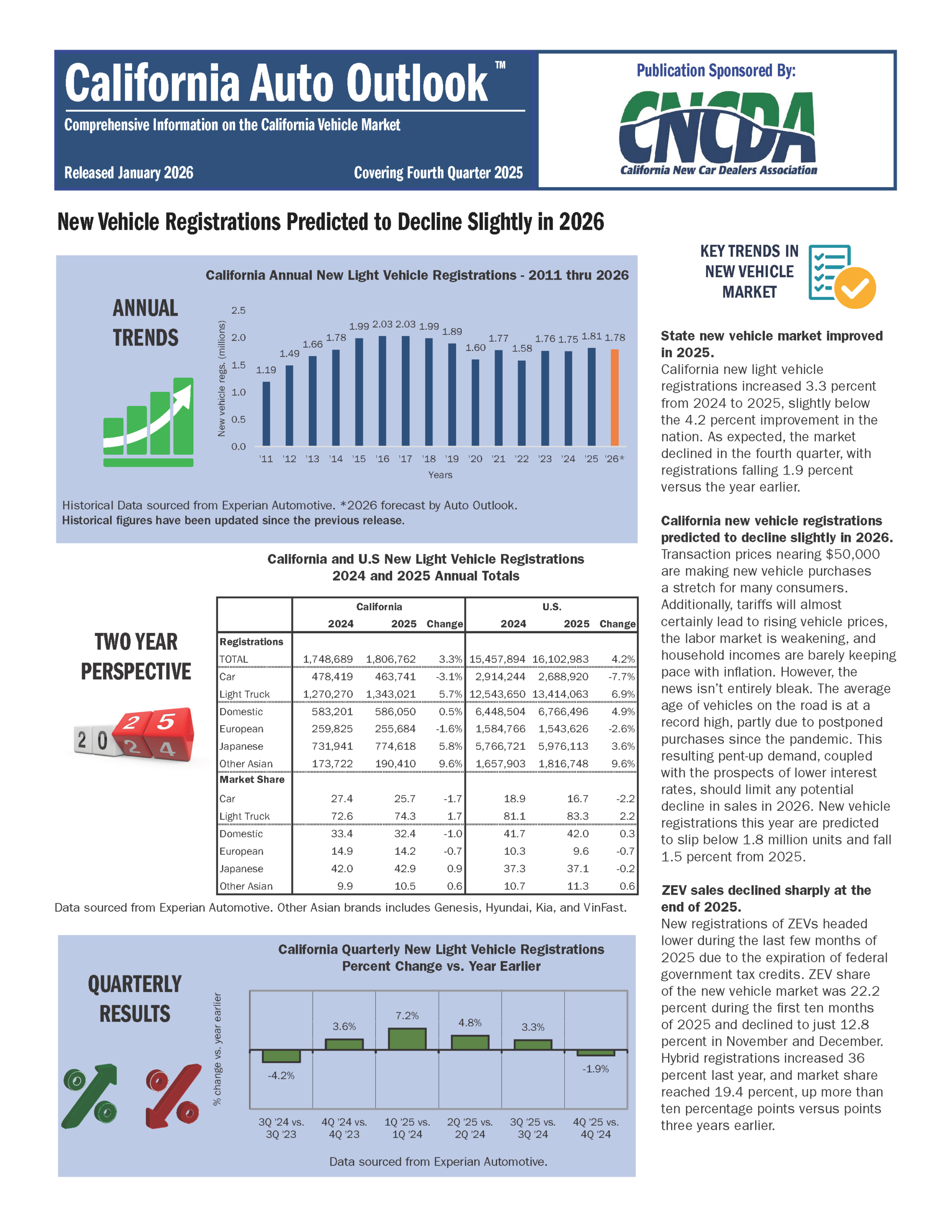
Key Takeaways California’s new vehicle market closed 2025 on a solid footing, posting a 3.3 percent increase in registrations, despite rising transaction prices, incentive expirations, higher interest rates, and economic uncertainty. This increase marks another year of overall market stability, underscoring continued consumer demand across vehicle segments.
At the same time, electric vehicle momentum reversed course.
After several years of growth following the pandemic, ZEV (zero-emission vehicle) registrations declined in 2025 to 20.9 percent of the market, down from a peak of 22.0 percent in 2024. This marks the first year-over-year decline in ZEV registrations since 2020.
While cumulative ZEV totals continue to grow over time, registration data show that consumer adoption softened materially in late 2025, raising questions about the pace of future growth in California’s ZEV market.
The drop became especially pronounced in the last two months of the year. ZEV registrations in November and December fell below 13 percent, a sharp pullback following the third-quarter surge driven by the impending expiration of federal tax credits. Data confirms that the Q3 spike in registrations represented a pull-forward of demand rather than sustained growth. Total fourth-quarter ZEV market share was 20.1 percent.
California’s share of total U.S. ZEV registrations in 2025 was 28.5 percent.
Hybrids Gain Ground as Californians Seek Practical Options While ZEV demand cooled, hybrid vehicles continued to gain traction, posting strong year-over-year growth in 2025. Hybrid registrations increased by more than 30 percent compared to last year and accounted for 19.4 percent of the market, just 1 point behind ZEV sales.
Notably, hybrid sales slightly outpaced ZEV sales in Q4 alone, capturing 20.4 percent of the market, reflecting sustained consumer interest in lower-emission options that do not require installation of charging infrastructure or major lifestyle changes.
Gas-powered vehicles remained the single largest segment of the market, accounting for more than half of all new vehicle registrations in 2025 (54 percent).
“California continues to lead the nation in vehicle sales and innovation because consumers trust their local dealers,” said Jessie Dosanjh, Owner of Stevens Creek Chevrolet, and CNCDA Chairman. “This trust is built over time. We help our customers navigate new technology, shifting incentives, and affordability concerns by offering electric, hybrid, and traditional vehicles that fit how Californians live and drive.”
Model Rankings Revisited California’s year-end model rankings underscore continued demand for both affordable and established, high-volume vehicles across passenger car and light truck segments.
The Toyota Camry remained the top-selling passenger car in California, widening its lead in 2025, posting 62,324 registrations and capturing 50.0 percent of the midsize and large car segment. The Honda Accord followed with 30,455 registrations (24.4 percent). In the small car segment, the Honda Civic led the market with 53,085 registrations, representing 30.4 percent of sales.
Among light trucks, the Tesla Model Y remained California’s top-selling model overall with 110,120 registrations, accounting for 8.2 percent of total light truck share. The Toyota RAV4 followed with 65,604 registrations (4.9 percent), while the Honda CR-V recorded 52,311 registrations (3.9 percent).
Pickup demand remained strong. The Toyota Tacoma led compact and midsize pickups with 45,258 registrations (51.3 percent in that segment), while the Ford F-Series topped the full-size pickup segment with 39,502 registrations, followed by the Chevrolet Silverado at33,634 registrations.
Brand Performance Highlights Several established brands posted notable gains in 2025, particularly those expanding hybrid and diversified powertrain offerings.
Toyota finished 2025 as California’s top-selling brand, with 17.8 percent market share, further widening its lead over competitors. Honda closed the year in second place, capturing 10.8 percent of the market. By contrast, Tesla registrations declined 11.4 percent in 2025 with market share dropping from 11.6 percent in 2024 to 9.9 percent in 2025 as it slipped to third place in the state. This extends a two-year downward trend for Tesla despite the temporary boost from federal incentives.
Regional Markets California’s new retail registrations increased 1.5 percent in 2025 to 1,582,031 vehicles, driven entirely by light truck growth. Note: This data does not include fleet purchases.
Northern California led the state, with registrations up 2.8 percent to 543,368 units. Light truck sales rose 4.3 percent, while passenger cars declined 1.6 percent. BEVs accounted for 24.6 percent of the Northern California market.
Southern California registrations increased 0.9 percent to 1,038,663 units. Passenger car sales fell 4.1 percent, while light trucks rose 2.9 percent. BEVs represented 21.8 percent of registrations.
Statewide Outlook After rising 3.3 percent in 2025 to 1.81 million registrations, California’s new vehicle market is expected to soften in 2026, with registrations projected to dip 1.5 percent to just under 1.8 million units amid higher transaction prices, tariff pressure, and a cooling labor market. While affordability issues persist, record-high vehicle age, pent-up replacement demand, and a potential dip in interest rates are expected to help insulate from steep declines.
California Auto Outlook Quarterly is produced for CNCDA by Auto Outlook, Inc., an independent research company that analyzes statewide and regional automotive markets. When reporting these auto industry trends, please acknowledge the Data Source: Experian Automotive.
The report provides comprehensive information on California’s new vehicle market, including annual trends, a two-year perspective, vehicle powertrain dashboard, segment watch, the top five models in each segment, brand scoreboards, regional comparisons, and more. Visit www.cncda.org.
About CNCDA
For over 100 years, the California New Car Dealers Association has represented California’s franchised new car and truck dealers. CNCDA members are primarily engaged in the retail sale and lease of new and used motor vehicles and provide automotive products, parts, services, and repairs.
In 2024, California’s franchised new car dealers sold more than 1.85 million new and used cars and trucks, employed more than 138,478 people, paid $8.83 billion in sales tax, and donated $70.75 million to charitable and civic organizations. CNCDA is the Nation’s largest state association of franchised automotive dealers, with nearly 1,200 members, and provides legal compliance and legislative, regulatory, and legal advocacy.
California New Car Dealers Association Releases Q3 2025 Auto Outlook
Contact: Autumn Heacox, Director of Communications & Marketing: aheacox@cncda.org, (916) 441-2599 x105
Q3 2025 CA Auto Outlook: ZEVs Surge to One in Four Sales as Federal Tax Credit Ends
Tesla Hits Two-Year Slump; Toyota Makes Gains
Click on the image to view the report.
SACRAMENTO, CA, October 22, 2025— The California New Car Dealers Association (CNCDA) today released its Q3 2025 California Auto Outlook report, providing an analysis of statewide new vehicle registration trends. All data in the report is sourced from Experian Automotive; please cite when referencing these findings.
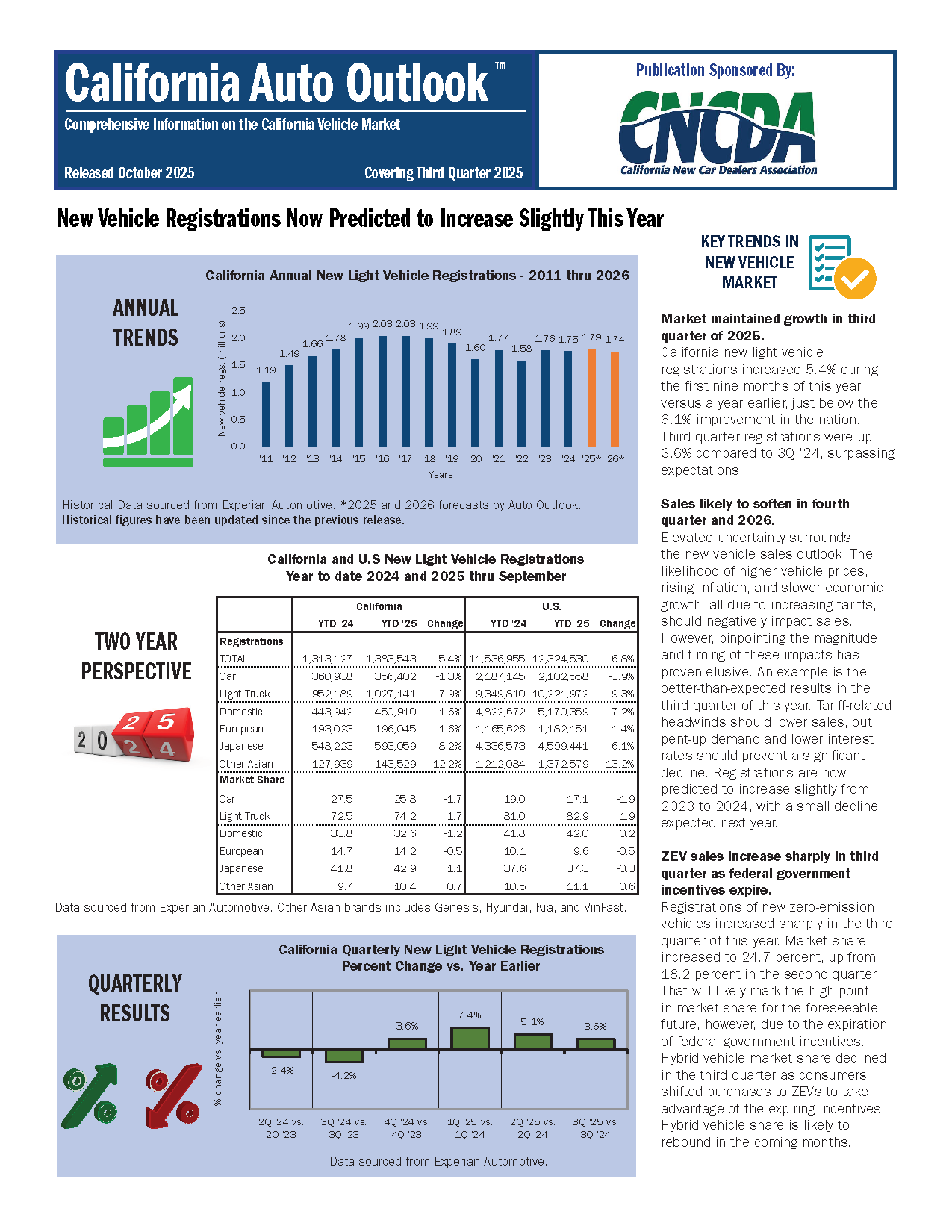
Key Takeaways California’s new light vehicle market continued its steady climb through the third quarter, with registrations rising 5.4 percent YTD and 3.6 percent in Q3 compared to the same period in 2024. The state is on track to see a modest annual increase by year-end.
The quarter’s most striking shift came in zero-emission vehicle (ZEV) sales, which spiked to 24.7 percent of the market. The increase was likely fueled by consumers rushing to purchase electric vehicles before September’s federal tax credit expiration. Despite this short-term lift, ZEV market share stands at 21.2 percent YTD, short of 2024’s posted 22 percent, signaling continued challenges for sustained EV adoption.
Tesla Slides as Toyota Shines Tesla has fallen for two straight years in the Golden State as registrations declined 15.1 percent YTD, dropping 9.4 percent in Q3. Toyota reigned again this quarter as California’s top-selling brand, capturing 17.4 percent of the state’s market share compared to Tesla’s 9.8 percent. Toyota registrations continue to climb, posting the most significant market share gain among all brands with a 1 percent increase YTD, and a sizable 2.4 percent jump in Q3.
The Toyota Camry also beat out Tesla’s Model 3 as the top-selling passenger car YTD, capturing 12.8 percent of the market.
Alternative Powertrain Registrations on the Rise While the ZEV market was unusually strong this quarter, hybrid registrations accounted for 18.9 percent of new registrations in Q3, posting 19.1 percent YTD. This surpasses 2024’s 14.8 percent hybrid total, suggesting that Californians want cleaner transportation options. However, they also prefer a balanced, gradual transition to the electrification of their personal transportation.
“Dealers are seeing real enthusiasm from customers for the latest hybrid and electric technologies, especially as the mainstay brands expand their lineups,” said Robb Hernandez, CNCDA Chairman and president of Camino Real Chevrolet. “Californians want choices that fit their lives and budgets. Our dealers are here to provide hybrids, EVs, or gas-powered options that meet them where they are.”
Combined sales of hybrids, plug-in hybrids, and zero-emission vehicles have reached 44.1 percent YTD, showing progress toward cleaner transportation in the state, but not at the all-electric pace policymakers envisioned. Despite ZEVs reaching their highest quarterly share (24.7 percent) since early 2023, the spike is expected to fade now that federal tax credits have expired.
The California Air Resources Board’s Advanced Clean Cars II (ACC2) mandate continues to face legal uncertainty after being struck down earlier this year under the Congressional Review Act. The ACC2 mandate excluded all hybrids and many PHEV models. While litigation is ongoing, policymakers’ goal of 100 percent ZEV sales by 2035 remains far from current consumer trends, and it is highly unlikely that ZEV sales would have met the initial 35 percent threshold for model year 2026.
Brand and Model Rankings Toyota leads the California market, followed by Honda (10.9 percent), Tesla (9.8 percent), Ford (7.7 percent), and Chevrolet (6.5 percent).
Top passenger car models include the Toyota Camry (45,617 registrations), Tesla Model 3 (44,173), and Honda Civic (41,130). Leading light trucks include the Tesla Model Y (79,448), Toyota RAV4 (49,584), and Honda CR-V (41,217).
Brands showing notable growth YTD include Buick, Jeep, Acura, Genesis, Cadillac, and Land Rover, each posting increases above 20 percent compared to Q3 2024.
Regional Trends Northern California outpaced the rest of the state, with registrations up 5 percent and a ZEV share of 24.9 percent. Southern California saw a 2.9 percent gain, with ZEVs accounting for 22.2 percent. The San Francisco Bay Area, Los Angeles/Orange Counties, and San Diego County all posted moderate growth.
Franchised dealerships continue to lead in consumer engagement and accessibility, accounting for nearly half (49.7 percent) of all ZEV sales in the state, a gain from 40.8 percent one year ago.
Statewide Outlook With the federal EV credit now expired, economists expect ZEV sales to normalize in Q4 as market forces and consumer preferences rebalance. The state’s total new vehicle registrations are projected to reach 1.74 million units in 2025, a slight increase from 2024.
California Auto Outlook Quarterly is produced for CNCDA by Auto Outlook, Inc., an independent research company that analyzes statewide and regional automotive markets. When reporting these auto industry trends, please acknowledge the Data Source: Experian Automotive.
The report provides comprehensive information on California’s new vehicle market, including annual trends, a two-year perspective, vehicle powertrain dashboard, segment watch, the top five models in each segment, brand scoreboards, regional comparisons, and more. Visit www.cncda.org.
About CNCDA
For over 100 years, the California New Car Dealers Association has represented California’s franchised new car and truck dealers. CNCDA members are primarily engaged in the retail sale and lease of new and used motor vehicles and provide automotive products, parts, services, and repairs.
In 2024, California’s franchised new car dealers sold more than 1.85 million new and used cars and trucks, employed more than 138,478 people, paid $8.83 billion in sales tax, and donated $70.75 million to charitable and civic organizations. CNCDA is the Nation’s largest state association of franchised automotive dealers, with nearly 1,200 members, and provides legal compliance and legislative, regulatory, and legal advocacy.
CNCDA Files Lawsuit Against Sony Honda for Violation of California Franchise Laws
American Honda/Sony Honda Mobility Circumventing Dealer Partners in Afeela Sales
Contact: Autumn Heacox, Director of Communications & Marketing: aheacox@cncda.org, (916) 441-2599 x105
Sony Honda and its partners are operating in direct violation of Assembly Bill 473 (AB 473), a 2023 law prohibiting automakers from using affiliated brands to compete with their own franchised dealers. Despite this law, Sony Honda and its partners are taking $200 deposits directly from California consumers through its website for upcoming Afeela vehicles, thus bypassing the state’s Honda and Acura dealerships.
“This is a direct attack on the 161 franchised Honda and Acura dealers in California that have been loyal partners in building the brand’s reputation and success for decades,” said Brian Maas, CNCDA President. “At the time of AB 473’s review by the California legislature, Sony Honda sought to block the (now) law that would make their direct sales of Afeela vehicles illegal. They are now knowingly violating the law, hoping they won’t be caught. It’s our job to protect the dealers who are directly harmed by their actions.”
“By cutting dealers out, they’re stripping vital consumer protections like local service support, transparent pricing, and warranty assistance, all while undermining the millions these dealers have invested in their facilities, employees, and communities. We will not allow a manufacturer to turn its back on the very network that made it profitable in the first place,” said Maas.
CNCDA is seeking immediate injunctive relief to halt these unlawful sales, along with enforcement of state law to protect California’s dealer network and the consumers they serve.
California’s franchised dealers are key economic drivers, selling more than 1.85 million new cars and trucks, employing over 138,000 Californians, and generating more than $8.8 billion in sales tax revenue. In 2024, dealers donated nearly $71 million to charitable and civic organizations statewide.
For over 100 years, the California New Car Dealers Association has represented California’s franchised new car and truck dealers. CNCDA members are primarily engaged in the retail sale and lease of new and used motor vehicles and provide automotive products, parts, services, and repairs. CNCDA is the Nation’s largest state association of franchised automotive dealers, with nearly 1,200 members, and provides legal compliance and legislative, regulatory, and legal advocacy.
California New Car Dealers Association Releases Q2 2025 Auto Outlook
Contact: Autumn Heacox, Director of Communications & Marketing: aheacox@cncda.org, (916) 441-2599 x105
Q2 2025 CA Auto Outlook: Tesla Sales Nosedive, Dragging Down ZEV Market Hybrids Surge, ICE Holds Steady, and Tariff Uncertainty Looms
Click on the image to view the report.
SACRAMENTO, CA, July 22, 2025— Today, the California New Car Dealers Association (CNCDA) released its Q2 2025 California Auto Outlook Report, analyzing new vehicle registration trends for the first half of the year. All data in the report is sourced from Experian Automotive and must be cited when referencing these findings.
Key Takeaways Seven appears unlucky for Tesla, as this is the most recent number of quarterly registration declines reported in the state. The electric-only automaker experienced an 18.3 percent drop in registrations compared to the first half of 2024. The direct-to-consumer automaker lacks a robust dealership network for sales support, which may have contributed to a 2.7 point decline in its market share year-to-date, with Q2 alone seeing a 2.9 point decrease. This decline pulled down the overall Zero Emission Vehicle (ZEV) share in the state, which fell to 18.2 percent this quarter and 19.5 percent year-to-date, down from 22.0 percent in 2024.
Alternatively, hybrid vehicles are gaining momentum and paving the way for a cleaner, greener California. Registrations for hybrids have climbed 54 percent so far this year, now accounting for 19.2 percent of the market, totaling 181,192 registrations. Gasoline and diesel vehicles continue to lead, with internal combustion engine (ICE) models making up 57.5 percent of the market.
“Dealers are focused on what Californians are buying, not just what policymakers want them to buy,” said Robb Hernandez, CNCDA Chairman and president of Camino Real Chevrolet. “It’s clear many consumers still face barriers to going fully electric, whether that’s due to affordability, lack of infrastructure, or range anxiety. Dealers are here to help customers find what works for their lives, whether that’s a ZEV, a hybrid, or a traditional gas-powered vehicle.”
ZEV Progress Slows as Policy Clouds Gather California’s Advanced Clean Cars II (ACC2) regulation, which required 100 percent ZEV sales by 2035, has encountered legal and political headwinds. The rule, set to take effect starting with model year 2026, required each manufacturer to sell 35 percent ZEVs, which would have been a massive long shot considering this quarter’s backslide to just 18.2 percent of ZEV sales (the lowest since Q3 2022).
While the mandate was invalidated earlier this year under the federal Congressional Review Act, litigation from the Newsom administration is ongoing, and the future of ACC2 (or a newly revised version) remains uncertain.
With hybrids gaining popularity and Tesla’s decline dragging down overall ZEV numbers, California policymakers’ ZEV-only strategy may need realignment. Notably, combined alternative powertrain vehicles (hybrid, plug-in hybrid, BEV, and fuel cell vehicles) account for 42.5 percent of new vehicle registrations statewide. Meanwhile, the state’s share of national ZEV registrations remains strong at 28.6 percent.
Brand Market Share and Summary Toyota continues to lead the California market with a 17.3 percent share, followed by Honda (11 percent), Tesla (8.8 percent), Ford (7.7 percent), and Chevrolet (6.6 percent). Brands showing strong year-to-date growth include Buick, Jeep, Acura, Genesis, Cadillac, Land Rover, and Chevrolet, each posting increases of over 20 percent in registrations compared to the same period last year.
Model Segment Rankings Top-selling passenger cars so far this year include the Tesla Model 3 with 31,394 registrations (12.6 percent share), followed closely by the Toyota Camry at 30,490 (12.2 percent), and the Honda Civic at 28,531 (11.5 percent).
Leading light truck models include the Tesla Model Y (6.3 percent share), Toyota RAV4 (4.9 percent), and Honda CR-V (4.3 percent).
Regional Variances Regional data shows steady growth across the state. The San Francisco Bay Area rose 3.4 percent, Los Angeles and Orange Counties climbed 2.3 percent, and San Diego County increased by 2.5 percent. Northern California led the state in BEV share at 23.0 percent, while Southern California held at 20.7 percent.
Statewide Impacts Despite a strong start to the year, rising tariffs, inflation, and consumer caution may soften California’s automotive outlook for the second half of 2025. Statewide, 944,834 new vehicles were registered during the first half of 2025, marking a 6.6 percent increase over the same period last year. New vehicle registrations were also up 5.5 percent in Q2 2025 compared to Q2 2024. The forecast for total 2025 registrations is 1.72 million, slightly below last year’s 1.75 million total.
California Auto Outlook Quarterly is produced for CNCDA by Auto Outlook, Inc., an independent research company that analyzes statewide and regional automotive markets. When reporting these auto industry trends, please acknowledge the Data Source: Experian Automotive.
The report provides comprehensive information on California’s new vehicle market, including annual trends, a two-year perspective, vehicle powertrain dashboard, segment watch, the top five models in each segment, brand scoreboards, regional comparisons, and more. Visit www.cncda.org.
About CNCDA
For over 100 years, the California New Car Dealers Association has represented California’s franchised new car and truck dealers. CNCDA members are primarily engaged in the retail sale and lease of new and used motor vehicles and provide automotive products, parts, services, and repairs.
In 2024, California’s franchised new car dealers sold more than 1.85 million new and used cars and trucks, employed more than 138,478 people, paid $8.83 billion in sales tax, and donated $70.75 million to charitable and civic organizations. CNCDA is the Nation’s largest state association of franchised automotive dealers, with nearly 1,200 members, and provides legal compliance and legislative, regulatory, and legal advocacy.
CNCDA Files Lawsuit Against Volkswagen and Scout Motors for Violation of California Franchise Laws
Contact: Autumn Heacox, Director of Communications & Marketing: aheacox@cncda.org, (916) 441-2599 x105
Scout Motors Bypassing Dealer Partners
SACRAMENTO, CA, April 22, 2025— Today, the California New Car Dealers Association (CNCDA) filed a lawsuit in San Diego County Superior Court against Volkswagen and its affiliate, Scout Motors, for deliberately violating California’s franchise laws. The lawsuit asserts that Volkswagen is illegally competing with its dealer partners through its affiliate, Scout Motors.
Volkswagen and Scout Motors are operating in direct violation of California Assembly Bill 473, a 2023 law that prohibits automakers from using affiliated brands to compete with their own franchised dealers. Despite admitting to legislative leaders that AB 473 would cut off its ability to sell directly to consumers, Volkswagen, via Scout Motors, has taken deposits and is marketing Scout-branded vehicles to California consumers.
“While CNCDA represents 45 Volkswagen dealerships in California, this lawsuit sends a message to every automaker,” said Brian Maas, CNCDA President. “VW dealers would welcome the opportunity to sell Scout trucks and SUVs, but their manufacturer business partner is denying them that opportunity, in direct violation of California law. Volkswagen can’t pick and choose which vehicles to sell on its own or through its franchised dealer network, reserving the most profitable or desirable vehicles for itself. Illegal competition will harm not only dealers but also the communities and car buyers that they serve. That is why the Legislature unanimously approved this important law.”
The lawsuit alleges unfair competition and false advertising, and CNCDA is seeking to immediately stop Scout Motors’ illegal direct sales, as well as civil penalties that could exceed $35 million.
California’s franchised dealers are key economic drivers, employing over 135,000 Californians and generating more than $8 billion in tax revenue for state and local governments. They also donated almost $71 million to charitable organizations in 2024 alone. CNCDA is committed to protecting the laws that ensure fair competition and a level playing field for all.
For over 100 years, the California New Car Dealers Association has represented California’s franchised new car and truck dealers. CNCDA members are primarily engaged in the retail sale and lease of new and used motor vehicles and provide automotive products, parts, services, and repairs.
In 2024, California’s franchised new car dealers sold more than 1.85 million new and used cars and trucks, employed more than 138,478 people, paid $8.83 billion in sales tax, and donated $70.75 million to charitable and civic organizations. CNCDA is the Nation’s largest state association of franchised automotive dealers, with nearly 1,200 members, and provides legal compliance and legislative, regulatory, and legal advocacy.
California New Car Dealers Association Releases Q1 2025 Auto Outlook Report
Contact: Autumn Heacox, Director of Communications & Marketing: aheacox@cncda.org, (916) 441-2599 x105
Q1 2025 CA Auto Outlook Report: Tesla Tumbles with Sixth Straight Quarterly Decline; Slows CA’s ZEV Market Overall Market (and Hybrids) Make Strides
Statewide Impacts Tesla’s troubles continue to worsen as Californians are giving the cold shoulder to the direct-to-consumer automaker (and controversial owner, Elon Musk). Registrations show a massive decline of 15.1 percent through March vs. this time last year. A year and a half of continuous quarterly declines proves this downward trajectory for Tesla is a lasting trend. The company’s market share also dropped by 11.6 percent at the end of Q1, now holding less than half of the California Zero Emission Vehicle (ZEV) market for the year.
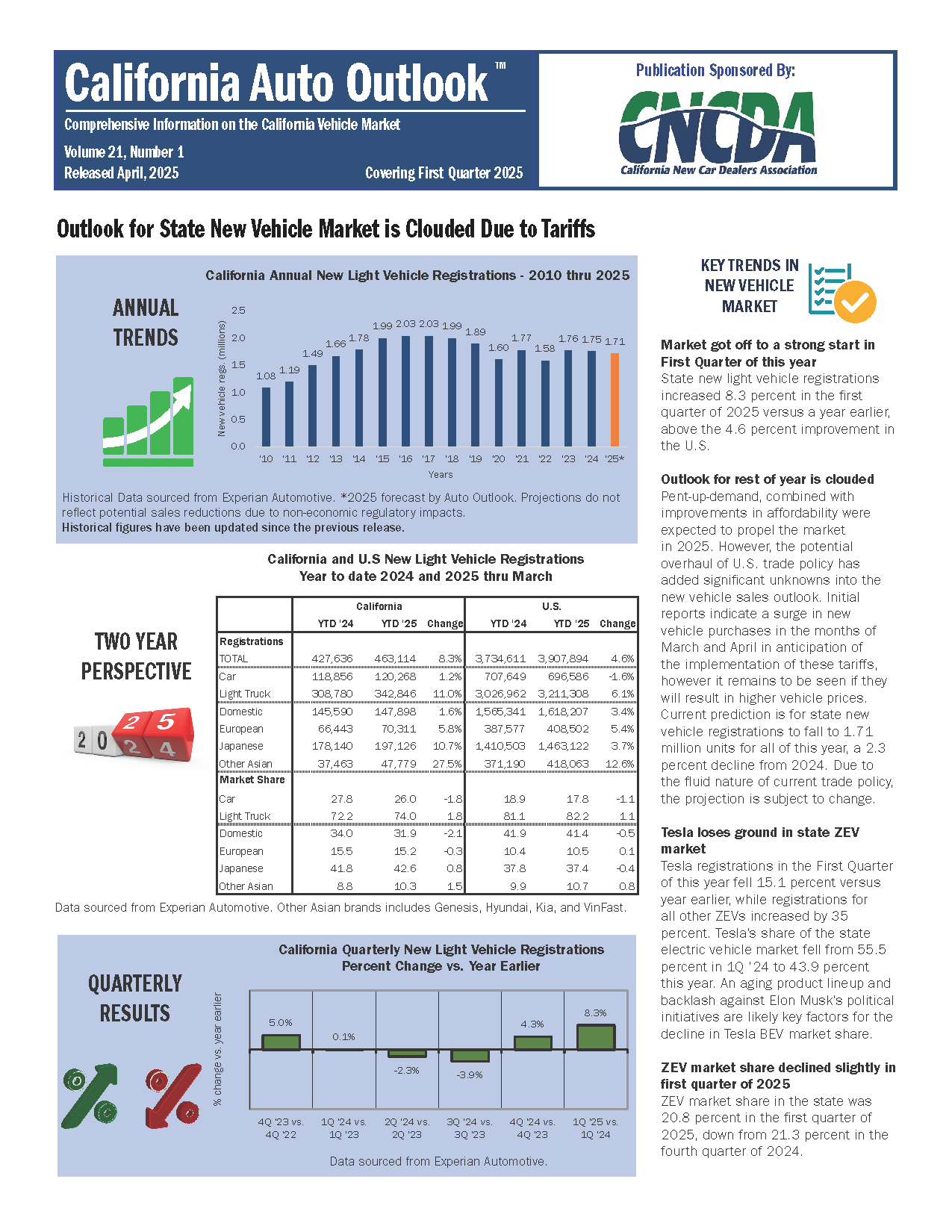
Tesla’s shrinking sales are dragging down the state’s zero-emission vehicle sales momentum. California posted a second quarterly decline in ZEV registrations, holding just 20.8 percent of the market share (down from 22 percent in 2024).
The state’s ZEV market share would need to increase by 14.2 share points to meet the California Air Resources Board’s Advanced Clean Cars II mandated level of 35 percent for 2026 model year vehicles (representing a 68 percent increase in ZEV registrations). The state’s franchised new car and truck dealers begin selling 2026 model year vehicles in a matter of weeks.
“Dealers sell what customers want to buy. No mandate can force consumers to choose otherwise. Although the manufacturers we represent are increasing EV sales in California, with the substantial decline in Tesla sales, EV market penetration is largely flat. This puts us well short of EV sales mandates that take effect this year,” said Robb Hernandez, CNCDA’s Chairman and President of Camino Real Chevrolet.
Key Highlights Still, the California sun is shining on the automotive market. Overall, new vehicle registrations among all brands showed a massive 8.3 percent growth from this time last year. A promising 463,114 vehicles were registered in the Golden State last quarter. Another bright light: California’s hybrid market is soaring. Hybrids now hold 17.9 percent of the market share, coming closer than ever to reaching the state’s ZEV numbers.
However, the forecast is cloudy with uncertain predictions for the remainder of 2025; registrations are now expected to dip 2.3 percent to 1.71 million for the full year. Looming trade policy changes have thrown a wrench into the outlook. A rush of buying in March and April, likely ahead of anticipated tariffs, may be short-lived if vehicle prices spike.
Brand Market Share and Summary Among all powertrains and brands, Toyota tops California, with 76,625 registrations in Q1, holding 16.5 percent of California’s market share. Honda jumped up a spot this quarter to take 10.8 percent of the market share. And Tesla came in third, with 9.1 share of California’s market, losing 2.6 percent from this time last year.
Toyota also leads California’s light truck market with Ford and Honda in second and third.
Several brands racing ahead with registrations improving by 30 percent (or more) YTD include: Buick, Mitsubishi, Genesis, Chrysler, Cadillac, Land Rover, Nissan, and Hyundai.
Model Segment Rankings California’s best sellers in the primary segments so far in 2025 are the Toyota Camry, Tesla Model 3, Honda Civic, Toyota Tacoma, Ford F-Series, Toyota RAV4, Honda Prologue (which also took third place in the alternative powertrain market), and the Lexus RX.
The top three passenger cars sold this quarter were the Tesla Model 3 (11.6 percent of share), the Toyota Camry (holding 11.5 percent) and the Honda Civic with 10.7 percent of California’s market share. The top three light trucks sold were the Tesla Model Y (6.8 percent share), the Toyota RAV4 (4.9 percent share), and the Honda CR-V (4 percent share).
Regional Variances Northern California passenger car sales were up .8 percent, and light trucks were way up with an 8.4 percent increase in registrations. BEVs account for 24.6 percent of Northern California’s market share. In Southern California, passenger car registrations were down 3.1 percent, while light trucks grew 7.1 percent, with BEVs taking a 23 percent share of the market.
California Auto Outlook Quarterly is produced for CNCDA by Auto Outlook, Inc., an independent research company that analyzes statewide and regional automotive markets. When reporting these auto industry trends, please acknowledge the Data Source: Experian Automotive.
The report provides comprehensive information on California’s new vehicle market, including annual trends, a two-year perspective, vehicle powertrain dashboard, segment watch, the top five models in each segment, brand scoreboards, regional comparisons, and more. Visit www.cncda.org.
About CNCDA
For over 100 years, the California New Car Dealers Association has represented California’s franchised new car and truck dealers. CNCDA members are primarily engaged in the retail sale and lease of new and used motor vehicles and provide automotive products, parts, services, and repairs.
In 2024, California’s franchised new car dealers sold more than 1.85 million new and used cars and trucks, employed more than 138,478 people, paid $8.83 billion in sales tax, and donated $70.75 million to charitable and civic organizations. CNCDA is the Nation’s largest state association of franchised automotive dealers, with nearly 1,200 members, and provides legal compliance and legislative, regulatory, and legal advocacy.
CNCDA Donates $100,000 to NADA Relief Fund for SoCal Wildfire Victims
CNCDA Donates $100,000 to NADA Relief Fund for SoCal Wildfire Victims
SACRAMENTO, CA, February 4, 2025— Today, the California New Car Dealers Association (CNCDA) announced a major donation to support individuals affected by the devastating wildfires in Southern California. CNCDA is donating $100,000 to the National Automobile Dealers Association (NADA) Foundation’s Emergency Relief Fund.
This donation, unanimously approved by the CNCDA Board of Directors last month, will directly help dealership employees and their families significantly impacted by this disaster.
The wildfires have caused significant destruction across the region, forcing several dealerships to close their doors temporarily and, in some cases, devastating many employees’ homes.
“We were deeply concerned to hear about the wildfires in Southern California. We’ve been in close communication with our dealer members and have extended our support for their employees who were most affected by this crisis, ensuring they are safe and cared for. CNCDA’s members remain committed to providing assistance to their fellow dealers in the aftermath of this tragedy,” noted Brian Maas, CNCDA President.
The NADA Emergency Relief Fund offers financial assistance to dealership employees impacted by disasters, with grants of up to $1,500 available to help those in need.
“For years, the NADA Emergency Relief Fund has been there to help dealership employees and their families recover from natural disasters like hurricanes, wildfires, tornadoes, and floods. Contributions like this one from CNCDA are only possible thanks to the generosity of dealers across the country. CNCDA’s significant donation is especially meaningful, given how hard Southern California has been hit by these fires. It truly shows how dedicated California dealers are to taking care of their own, especially during times of crisis,” added Mike Stanton, NADA President and CEO.
CNCDA’s contribution reinforces our members’ commitment to supporting the communities in which they operate, especially in times of hardship.
For over 100 years, the California New Car Dealers Association has represented California’s franchised new car and truck dealers. CNCDA members are primarily engaged in the retail sale and lease of new and used motor vehicles and provide automotive products, parts, services, and repairs. In 2023, California’s franchised new car dealers sold more than 1.77 million new cars and trucks, employed more than 138,807 people, paid $8.74 billion in sales tax, and donated $67.66 million to charitable and civic organizations. CNCDA is the Nation’s largest state association of franchised automotive dealers—with nearly 1,200 members— and provides legal compliance and legislative, regulatory, and legal advocacy.
California New Car Dealers Association Releases Q3 2024 Auto Outlook Report
Q3 2024 CA Auto Outlook Report: Tesla Sales Slip 12.6% in 2024 Combined Share for CA’s Hybrid and Electric Vehicles Sales Reaches 39.4%
Click on the image to view the report.
SACRAMENTO, CA, October 25, 2024— Today, the California New Car Dealers Association (CNCDA) released its California Auto Outlook covering the first three quarters of 2024. The report summarizes California’s new vehicle registrations and predicts anticipated yearly sales. For accurate reporting, please cite Experian Automotive as the data source for CNCDA’s Auto Outlook.
Key Highlights California’s new light vehicle registrations fell by 1.7 percent YTD versus the year earlier, totaling 1,320,708. The State is forecasted to reach 1.75 million new vehicle registrations by year-end. Overall sales in 2023 reached 1.77 million, indicating a flat YOY prediction. Additionally, early 2025 estimates remain in the narrow range, with total projected sales to reach 1.79 million.
New vehicle registrations in the Golden State seem to be leveling off post-pandemic with a new yearly average benchmark. Three of the past four years have totaled approximately 1.76 million registrations, far less than the pre-pandemic years (2015-2019), which hovered just above 2 million registrations. Affordability remains a key issue holding back numbers, but lower interest rates, falling inflation, increasing employment, and rising incentives may help sales rise into 2025.
Tesla’s Model Y remains the top-selling car in California year-to-date, but the company’s sales continue to slip, losing 8.5 percent market share compared to last year. This marks a full year of registration declines for Tesla in California, leaving the “alternative powertrain door” open for traditional automakers. Manufacturers and dealers have embraced this shift, expanding their share of battery electric vehicle (BEV) sales to 40.2 percent as consumers increasingly turn to exciting, new electric vehicle (EV) options.
Brands like Kia, BMW, and Hyundai have gained traction, increasing their year-to-date market shares by 1.4, 1.3, and 1.3 percents, respectively. Hyundai’s Ioniq 5 is now the third best-selling BEV in California.
YTD, BEVs currently comprise 22.2 percent of the State’s market share, showing a slight increase this year. When considering all alternative powertrains—plug-in hybrids (PHEVs), hybrids, and BEVs— these vehicles account for 39.4 percent of new sales in the first nine months of 2024, a significant increase from just 11.6 percent in 2018.
“California’s franchised dealers are here to meet the needs of our customers, whether they prefer traditional gas-powered vehicles or are shifting to electric or hybrid alternatives. We’re proud to be at the forefront of the Nation’s evolving auto industry, providing the choices and expertise Californians need as they navigate their options,” says David Simpson, CNCDA Chairman and owner of Simpson Buick GMC Cadillac of Buena Park, Simpson Chevrolet of Garden Grove, and Simpson Chevrolet of Irvine. “At the end of the day, it’s about serving our communities and offering vehicles that best suit their lifestyle while supporting a greener future in a way that aligns with consumer demand and affordability.”
Brand Market Share and Summary Among all powertrains, Toyota remains California’s preferred brand, with 215,402 registrations YTD and 16.3 percent of the market share.
Other YTD market share brand leaders: Tesla (with 12.1 percent market share) and Honda (with 10.9 percent market share). Honda also posted a noteworthy 11.2 percent increase in registrations this year, with 143,391 registrations YTD.
Still holding the position as California’s second best-selling brand, Tesla is grappling with significant hurdles. Its market share dropped by 12.6 points compared to last year, and Q3 2024 registrations fell by 3.5 percent from Q3 2023. This decline suggests that Tesla’s once-coveted appeal continues its downward trend, raising more concerns for the direct-to-consumer brand.
Five brands in the State have improved their registrations by 20 percent (or more) this year. These brands include Jaguar (222.6 percent), Buick (39.9 percent), Rivian (35.4 percent), Lincoln (27.6 percent), and Dodge (20 percent).
Model Segment Rankings Unchanged from the last two quarters, California’s best sellers in the primary segments in Q3 2024 include the Honda Civic, Toyota Camry, Tesla Model 3, Toyota Tacoma, Chevrolet Silverado, Toyota RAV4, Subaru Outback, and Lexus RX.
The top three passenger cars sold in California YTD saw variations from Q2. The Honda Civic is now the best-selling passenger car in California (with 40,741 registrations), followed by the Toyota Camry (40,025 registrations), with the Tesla Model 3 taking third place (37,219 registrations). The top three light trucks sold YTD were the Tesla Model Y (105,693 registrations), the Toyota RAV4 (49,810), and the Honda CR-V (37,759 registrations).
Regional Variances Northern California car registrations dropped 15.4 percent YTD, while light trucks were up .6 percent. Southern California cars also slipped by 12.3 percent. However, southern California light truck registrations saw a jump of 4.2 percent.
Regionally, the San Diego County market has been the most insulated from declines, with a -0.7 percent dip in YTD registrations. The San Francisco Bay Area market saw the largest dip in registrations, posting -4.3 percent this year.
California Auto Outlook Quarterly is produced for CNCDA by Auto Outlook, Inc., an independent research company that analyzes statewide and regional automotive markets. When reporting these auto industry trends, please acknowledge the data source: Experian Automotive.
The report provides comprehensive information on California’s new vehicle market, including annual trends, a vehicle powertrain dashboard, a segment watch, the top five models in each segment, brand scoreboards, regional comparisons, and more. Visit www.cncda.org.
About CNCDA
For 100 years, the California New Car Dealers Association has represented California’s franchised new car and truck dealers. CNCDA members are primarily engaged in the retail sale and lease of new and used motor vehicles and provide automotive products, parts, services, and repairs. In 2023, California’s franchised new car dealers sold more than 1.77 million new cars and trucks, employed more than 138,807 people, paid $8.74 billion in sales tax, and donated $67.66 million to charitable and civic organizations. CNCDA is the Nation’s largest state association of franchised automotive dealers—with nearly 1,200 members— and provides legal compliance and legislative, regulatory, and legal advocacy.
California New Car Dealers Association Releases Q2 2024 Auto Outlook Report
Q2 2024 CA Auto Outlook Report: Has Tesla Peaked in CA? Sales Slip 17% YTD; New Vehicle Registrations Decline Slightly; Ioniq 5 Steals Third Place in EVs
Click on the image to view the report.
SACRAMENTO, CA, July 18, 2024— Today, the California New Car Dealers Association (CNCDA) released its California Auto Outlook covering the first half of 2024. The report summarizes California’s new vehicle registrations and predicts anticipated yearly sales. For accurate reporting, please cite Experian Automotive as the data source for CNCDA’s Auto Outlook.
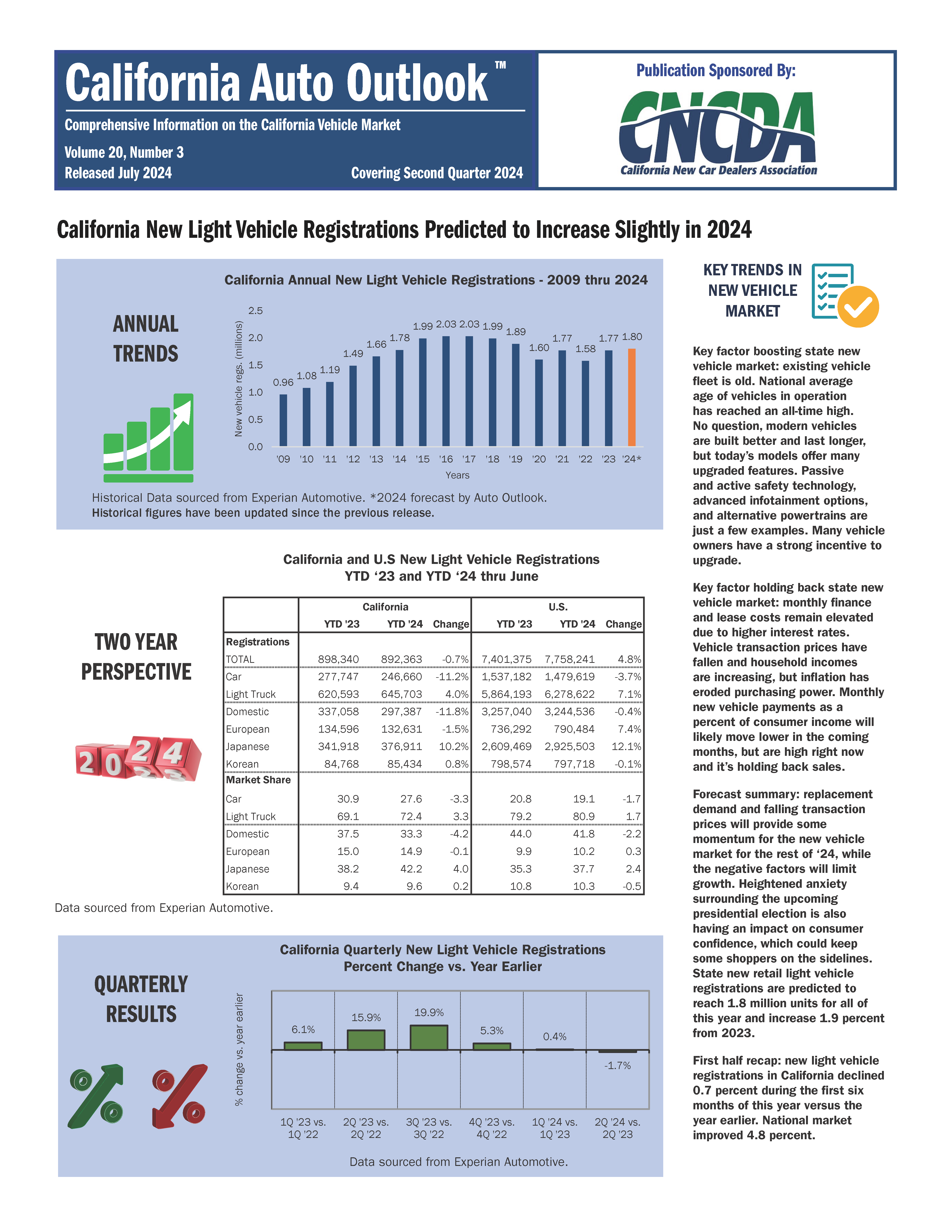
Key Highlights California’s new light vehicle registrations fell by .7 percent YTD compared to last year, totaling 892,363. Despite this decline, the State is on track to hit a forecasted 1.8 million new vehicle registrations by year-end. Higher interest rates and inflation are squeezing consumer budgets. Still, the aging vehicle fleet (at a record all-time high) and technology and safety upgrades in new models are keeping the market resilient.
Tesla’s future appears to be dwindling as the brand’s sales continue to decline in the Golden State; registrations are down a significant 17 percent YTD (as compared to last year). While Tesla’s Model Y remains the top-selling car in the State, Tesla sales may have peaked. This new data marks the brand’s third consecutive quarter with registration declines (dipping 24.1 percent in Q2 2024, 7.8 percent in Q1 2024, and 9.8 percent in Q4 2023).
In stark contrast, mainstay brands like Toyota, Hyundai, and Ford are on the upswing, with significant gains and excitement around new EV models that Californians seem eager to adopt. This year, Toyota’s BEV registrations rose 108.1 percent, and Hyundai’s BEV registrations rose 65.7 percent. Notably, the Hyundai Ioniq 5 stole third place (from Tesla’s Model X) of the top-selling EVs in California YTD, with 7,191 registrations.
Ford BEV sales rose by 26.4 percent, and the Mustang Mach-E became the fifth most-sold EV YTD. This surge underscores how the State’s franchised new car dealers are expertly navigating the evolving market, driving consumer enthusiasm with trusted, high-performing brands.
“It’s an exciting time to be a franchised car dealer in California. With new competitive EV models and the latest ICE options, we’re able to meet diverse customers’ needs and provide the support they want from their local dealership,” says David Simpson, CNCDA Chairman and owner of Simpson Buick GMC Cadillac of Buena Park, Simpson Chevrolet of Garden Grove, and Simpson Chevrolet of Irvine. “Our dealers are trusted community partners, providing Californians with high-quality, reliable vehicles- whether electric, traditional, or anything in between.”
Regardless of the powertrain, Toyota remains California’s top brand. With 150,964 registrations and 16.9 percent of the market share (a 2.1 point increase YTD from 2023), Toyota continues to lead the market.
Vehicle Powertrain Dashboard The report’s vehicle powertrain dashboard details the State’s BEV, hybrid, and PHEV sales and market health. California leads the nation in BEV registrations, with BEVs accounting for 21.4 percent of sales year-to-date. Thirty-three percent of nationwide BEV sales took place in California. The U.S. BEV market share is far less substantial, posting 7.5 percent YTD.
Additionally, after six months of declines, California’s BEV market share rose to 21.9 percent from 20.9 percent last quarter. The State’s hybrid registrations showed promise, jumping to 13.2 percent, and the PHEV market share remained steady at 3.4 percent this year.
In the first half of 2024, combined sales of BEVs, PHEVs, hybrids, and fuel cell vehicles in the Golden State accounted for 38 percent of the market share. Internal Combustion Engine (ICE) vehicles (gas and diesel) accounted for 62 percent of registrations.
California’s franchised new car and truck dealers account for over 67 percent of combined sales for all alternative powertrain types this year, demonstrating consumer confidence in local dealerships and mainstay brands. This trend is evident in the sales of BEVs by franchised dealerships, which have surged by 27 percent (while direct sellers, such as Tesla and Rivian, saw a 12.3 percent drop).
Model Segment Rankings Unchanged from last quarter, California’s best sellers in the primary segments in Q2 2024 include the Honda Civic, Toyota Camry, Tesla Model 3, Toyota Tacoma, Chevrolet Silverado, Toyota RAV4, Subaru Outback, and Lexus RX.
Brand Market Share and Summary Tesla, the second best-selling brand in California with 102,106 registrations YTD, is facing mounting challenges. Its market share dipped 2.3 points from last year, and Q2 2024 registrations plummeted 24.1 percent compared to Q2 2023. Tesla’s allure seems to be wearing off, signaling potential trouble for the direct-to-consumer manufacturer.
Honda also reported an impressive 12.9 percent jump YTD (reaching 94,939 registrations). As reported last quarter, the top three passenger cars sold were the Toyota Camry, the Honda Civic, and the Tesla Model 3. The top three light trucks were the Tesla Model Y, the Toyota RAV4, and the Honda CR-V.
Five brands in the State have improved registrations by more than 10 percent this year. These brands include Rivian (76.7 percent), Dodge (43.1 percent), Lexus (25.6 percent), Lincoln (23.3 percent), and Buick (19.5 percent).
Regional Variances Northern California’s BEV market share was 24.9 percent in the first half of this year, while Southern California’s share was 22.1 percent.
Specifically, light vehicle (non-fleet) registrations in N. and S. California showed declines of 3.3 and .1 percents, respectively. Regionally, the Bay Area posted a 3.2 percent decline, LA and Orange Counties increased slightly by .1 percent, and San Diego County’s sales increased by 1.6 percent, YTD.
California Auto Outlook Quarterly is produced for CNCDA by Auto Outlook, Inc., an independent research company that analyzes statewide and regional automotive markets. When reporting these auto industry trends, please acknowledge the data source: Experian Automotive.
The report provides comprehensive information on California’s new vehicle market, including annual trends, a vehicle powertrain dashboard, a segment watch, the top five models in each segment, brand scoreboards, regional comparisons, and more. Visit www.cncda.org.
About CNCDA
For 100 years, the California New Car Dealers Association has represented California’s franchised new car and truck dealers. CNCDA members are primarily engaged in the retail sale and lease of new and used motor vehicles and provide automotive products, parts, services, and repairs. In 2023, California’s franchised new car dealers sold more than 1.77 million new cars and trucks, employed more than 138,807 people, paid $8.74 billion in sales tax, and donated $67.66 million to charitable and civic organizations. CNCDA is the Nation’s largest state association of franchised automotive dealers—with nearly 1,200 members— and provides legal compliance and legislative, regulatory, and legal advocacy.
California New Car Dealers Association Releases Q1 2024 Auto Outlook Report
Q1 2024 CA Auto Outlook Report: Tesla Registrations Drop; Sales Slip 7.8% YTD Overall New Vehicle Registrations Up; Toyota Market Share Exceeds 16%
Click on the image to view the report.
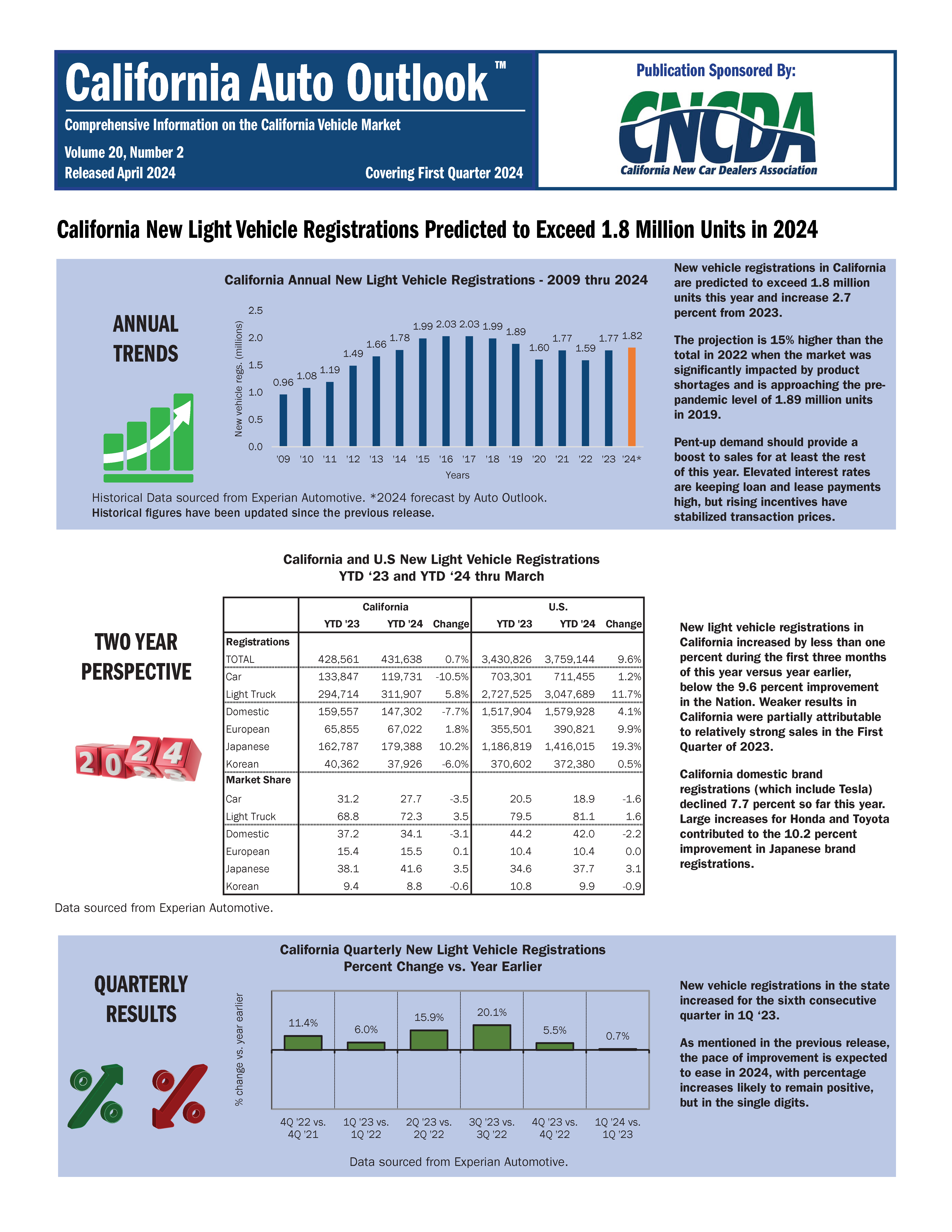
SACRAMENTO, CA, April 29, 2024— The California New Car Dealers Association (CNCDA) released its California Auto Outlook covering the first quarter of 2024 today. The report summarizes quarterly new vehicle registration figures statewide and predicts overall 2024 sales. Experian Automotive provides data for CNCDA’s Auto Outlook.
Californians’ love affair with electric vehicle giant Tesla may have peaked. Tesla registrations are down again in The Golden State YTD, reporting a 7.8 percent dip (last quarter posted a 9.8 percent decline) amongst all brand registrations. Toyota showed significant gains among the top three California shareholder brands, increasing to 16.6 percent, as did Honda, capturing 10.5 percent of the market, while Tesla’s numbers faltered (11.6 percent).
As Tesla’s dominance wanes, traditional manufacturers are stepping up to the plate, offering new plug-in hybrid (PHEV), hybrid, and battery electric vehicle (BEV) models. This shift is evident in the sales of BEVs by traditional franchised dealerships, which have surged by 14 percent (while direct sellers saw a three-point drop) compared to last year’s figures. Notably, franchised dealers account for over 66 percent of combined sales for all alternative powertrain types, demonstrating consumer confidence in local dealerships and mainstay brands (despite changing market dynamics).
“We’ve spent decades, even lifetimes, building trust with our neighbors, providing great jobs, and supporting our communities. Californians are smart. They recognize that we do our best to give customers high-quality cars they want at affordable price points,” says David Simpson, CNCDA Chairman and owner of Simpson Buick GMC Cadillac of Buena Park, Simpson Chevrolet of Garden Grove, and Simpson Chevrolet of Irvine. “This is why we believe the Tesla sales model is ineffective, layoffs are happening, and people are generally dissatisfied with their level of service. We take pride in our dealerships, and it shows.”
The first quarter of 2024 reports a slight increase in overall registrations at .7 percent (the sixth consecutive quarterly increase) in the State, posting 431,638 new sales. This figure is in contrast with the Nation’s 9.6 percent improvement. Weaker results in California are partially attributed to relatively strong sales in the first quarter of 2023.
California’s pace of improvement is expected to ease overall in 2024 compared to last year. While registrations are predicted to exceed 1.8M units, the increase will likely remain in the single digits.
Toyota once again secured its lead as the top brand in California, with a 9.3 percent increase in registrations, as did Honda, with an impressive 18.6 percent jump YTD. The top three passenger cars sold were the Toyota Camry, the Honda Civic, and dropping from first place to third, the Tesla Model 3. The top three light trucks were the Tesla Model Y, the Toyota RAV4, and the Honda CR-V.
Another brand of note this year is Dodge. Due to the recent introduction of the Hornet PHEV SUV, Dodge reported the second-highest positive change in California, with a 76.2 percent increase in new registrations last quarter.
Vehicle Powertrain Dashboard The report’s vehicle powertrain dashboard details the State’s BEV, hybrid, and PHEV sales and market health. The State’s BEV market share declined for the second quarter, falling to 20.9 percent from 21.5 percent at the end of 2023. Alternatively, the State’s hybrid registrations jumped again this quarter to 13 percent (up from 11.1 percent). California’s PHEV market share slightly increased, wrapping the first quarter at 3.6 percent.
Combined sales of BEVs, PHEVs, hybrids, and fuel cell vehicles in The Golden State accounted for 37.5 percent of the market share last quarter (up from just 11.6 percent in 2018). Internal Combustion Engine (ICE) vehicles (gas and diesel) accounted for 62.5 percent of registrations, dipping about 1.4 points from the end of 2023.
California continues to lead in BEV registrations, posting 32.5 percent of sales nationwide. The U.S. market share of BEV vehicles is far less substantial, posting 7.4 percent in Q1 2024.
Hybrid and Electric Vehicles Tesla may have the top three-selling electric vehicles in the State, however, first-quarter sales show a significant 6.4 percent YTD BEV market share loss. Mercedes and BMW showed the highest increases in BEV sales in the State last quarter, posting 3 and 2.4 percents, respectively.
Northern Californians continue to be the most significant adopters of BEVs, capturing 24.8 percent of the market share. Southern California BEV sales remained fairly level at 21.5 percent of sales last quarter.
Model Segment Rankings California’s best sellers in the primary segments in Q1 2024 include the Honda Civic, Toyota Camry, Tesla Model 3, Toyota Tacoma, Chevrolet Silverado, Toyota RAV4, Subaru Outback, and Lexus RX.
Brand Market Share and Summary Registrations for five brands in the state have improved by more than 22 percent so far this year. Brands showing the most significant positive percent increases were Rivian (87.1 percent), Dodge (76.2 percent), Lexus (37.3 percent), Lincoln (25.8 percent), and Volvo (22 percent).
The Golden State’s brand registration numbers do not mirror those of the rest of the U.S., which reports Toyota at 13.4 percent of the market share, Ford at 12.4 percent, and Chevy at 10.4 percent last quarter.
Regional Variances Specifically, Car retail registrations in N. and S. California showed declines of 11.8 and 6 percents, respectively. Light truck retail registrations were up by 2.9 percent in N. California and 5.3 percent in S. California. A shining star, San Diego County’s share increased by 4.6 percent with 35,561 registrations this year.
California Auto Outlook Quarterly is produced for CNCDA by Auto Outlook, Inc., an independent research company that analyzes statewide and regional automotive markets. When reporting these auto industry trends, please acknowledge the Data Source: Experian Automotive.
The report provides comprehensive information on California’s new vehicle market, including annual trends, a two-year perspective, vehicle powertrain dashboard, segment watch, the top five models in each segment, brand scoreboards, regional comparisons, and more. Visit www.cncda.org.
About CNCDA
For 100 years, the California New Car Dealers Association has represented California’s franchised new car and truck dealers. CNCDA members are primarily engaged in the retail sale and lease of new and used motor vehicles and provide automotive products, parts, services, and repairs. In 2023, California’s franchised new car dealers sold more than 1.77 million new cars and trucks, employed more than 138,807 people, paid $8.74 billion in sales tax, and donated $67.66 million to charitable and civic organizations. CNCDA is the Nation’s largest state association of franchised automotive dealers—with nearly 1,200 members— and provides legal compliance and legislative, regulatory, and legal advocacy.