
California New Car Dealers Association Releases Q3 2026 Auto Outlook
Contact: Autumn Heacox, Director of Communications & Marketing: aheacox@cncda.org, (916) 441-2599 x105
California Hybrid Market Share Hits New Record as New Vehicle Registrations Rebound
ZEV Share Flattens at 17 Percent as State’s New MyFirstEV Rebate Program Rolls Out
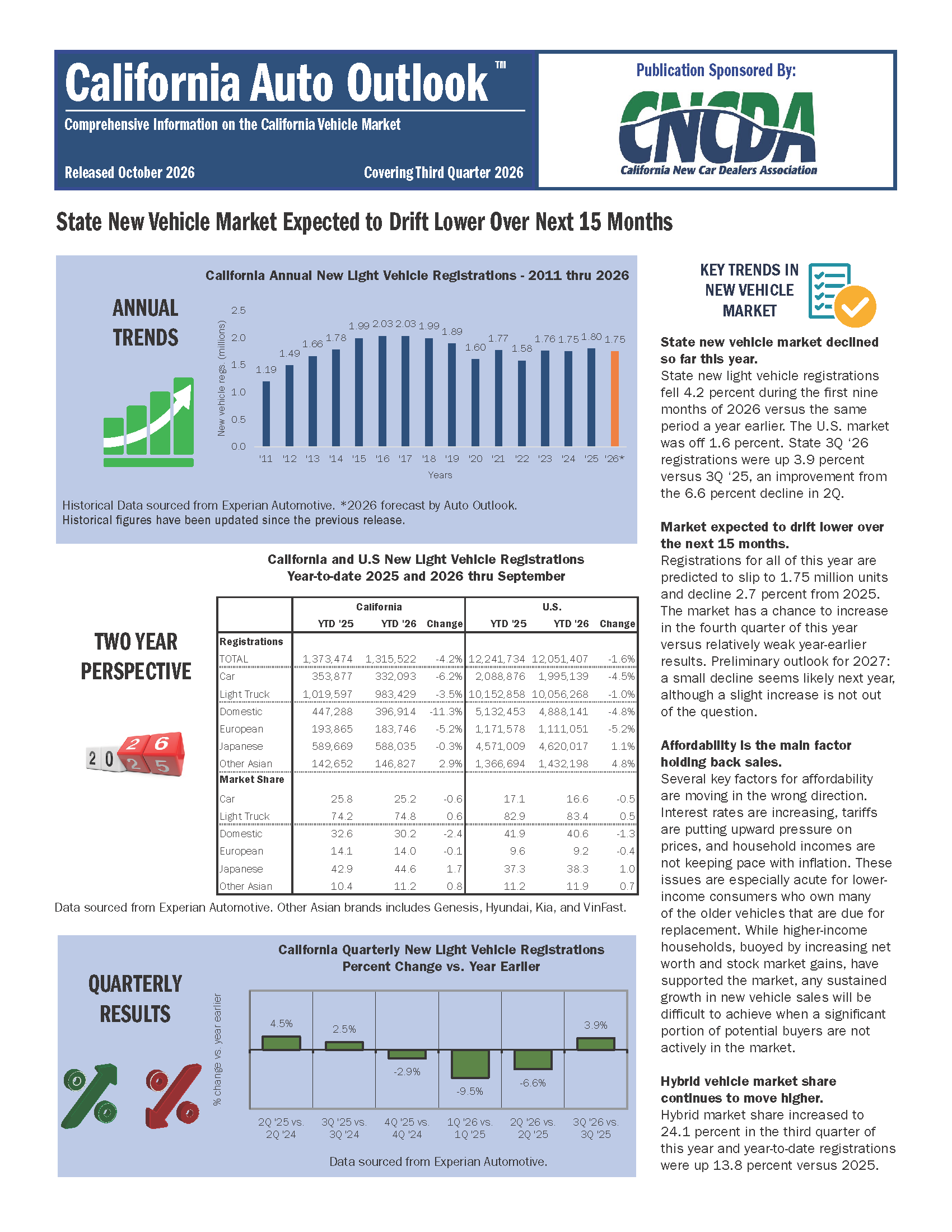
SACRAMENTO, CA (October 15, 2026) — Today, the California New Car Dealers Association (CNCDA) released its Q3 2026 California Auto Outlook report, providing a third-quarter analysis of statewide new vehicle registration trends. All data in the report is sourced from Experian Automotive and must be cited when referencing these findings.
Key Takeaways
California’s new vehicle market returned to growth in the third quarter, with registrations rising 3.9 percent compared to the third quarter of 2025. It was the first quarterly gain of 2026, following declines of 9.5 percent in Q1 and 6.6 percent in Q2. Year-to-date registrations through September totaled 1,315,522 units, down 4.2 percent from the same period in 2025. The U.S. market was off 1.6 percent.
Retail registrations, which exclude fleet sales, were down 5.3 percent through September compared with a 4.2 percent decline in the overall market, indicating fleet sales have outperformed retail this year.
Statewide registrations are projected to reach 1.75 million units for all of 2026, down 2.7 percent from 2025. Elevated transaction prices, rising interest rates, tariff pressure on vehicle prices, and household incomes that have not kept pace with inflation continue to weigh on affordability.
Drivetrain Update: Hybrids Reach a New High
Hybrid vehicles accounted for 22.8 percent of California’s new vehicle market through September, the highest share in the report’s data series and up from 19.5 percent for all of 2025. Hybrid share has now increased every quarter of 2026, climbing from 20.9 percent in the first quarter, to 23.2 percent in the second, to 24.1 percent in the third.
Hybrid registrations totaled 300,005 units through the first nine months of the year, and virtually every one was sold through a franchised new car dealership.
Franchised dealerships accounted for 75.4 percent of combined hybrid, ZEV, and plug-in hybrid registrations statewide. In the non-luxury passenger car segment, hybrids now capture more than 45 percent of all sales.
Gas-powered vehicles remained the largest single segment of the market at 56.3 percent of registrations, up from 54.0 percent in 2025.
ZEV registrations declined 26.1 percent through the first nine months of 2026 compared with a year earlier, falling to 215,467 units. ZEV market share was 16.4 percent year-to-date and 17.3 percent in the third quarter alone.
ZEV Market Stabilizes at Lower Level
After the sharp drop following the expiration of federal tax credits, the quarterly trend suggests a floor has formed. ZEV share fell from 24.9 percent in the third quarter of 2025 to 13.8 percent in the first quarter of 2026, then recovered to 17.9 percent in the second quarter before easing slightly to 17.3 percent in the third. California continues to lead the nation on electric vehicle adoption by a wide margin. The state’s ZEV share of 16.4 percent was more than two and a half times the U.S. figure of 6.2 percent, and California accounted for 28.9 percent of all ZEV registrations nationwide.
The state’s new point-of-sale rebate program, MyFirstEV, launched on August 3. Because the program was operational for less than two months of the third-quarter reporting period and included only a portion of the state’s ZEV brands at launch, meaningful market impact will become visible in fourth-quarter data and beyond.
“Affordability is driving every conversation on dealer lots right now. Transaction prices are high, interest rates are still elevated, and consumers are being careful about how they spend. Dealers are working to meet buyers where they are, matching them with vehicles that fit their budget and how they live. Hybrids are winning a lot of those conversations because they deliver real value from brands Californians already trust. California dealers are doing the work to close the gap between consumers’ wants and their budgets every day,” said Jessie Dosanjh, Owner of Stevens Creek Chevrolet and CNCDA Chairman.
Luxury Segments Drive Remaining EV Demand
The EV market in California is becoming increasingly concentrated at the top of the price range. ZEV and plug-in hybrid combined share exceeded 42 percent in the luxury car segment and reached 59 percent in the small luxury SUV segment through the first nine months of the year. In the non-luxury car segment, ZEV and PHEV combined share was just 2.3 percent. The gap underscores how affordability continues to shape powertrain decisions for most California households.
Model Rankings
The Toyota Camry was the top-selling passenger car in California with 52,224 registrations, capturing 54.8 percent of the midsize and large car segment. The Honda Accord followed with 25,057 registrations (26.3 percent). The Honda Civic led small cars with 42,238 registrations, representing 32 percent of the segment.
The Tesla Model Y remained California’s top-selling model overall with 86,099 registrations, accounting for 57.9 percent of the luxury compact SUV segment. The Honda CR-V led compact SUVs with 41,809 registrations at 19.4 percent. The Toyota RAV4 followed with 37,801 registrations at 17.5 percent.
The Toyota Tacoma led compact and midsize pickups with 36,330 registrations at 51.5 percent. The Ford F-Series topped full-size pickups with 28,507 registrations at 28.3 percent, followed by the Chevrolet Silverado at 24,248 registrations.
Brand Performance Highlights
Nine of the top 30 selling brands recorded registration increases through September: Lucid, Volvo, Genesis, Chrysler, Kia, Toyota, BMW, Mercedes-Benz, and Lexus.
Toyota finished the first nine months as California’s top-selling brand with 19.2 percent market share, up from 17.5 percent a year earlier. Honda followed in second place at 11.0 percent of the market. Tesla ranked third at 9.3 percent, down from 9.9 percent.
Regional Markets
Northern California new retail registrations, which exclude fleet sales, fell 6.7 percent to 387,819 units through September. Passenger cars declined 8.0 percent, and light trucks fell 6.2 percent. ZEVs accounted for 20.8 percent of the Northern California market.
Southern California retail registrations declined 4.6 percent to 755,504 units through September. Passenger cars fell 5.6 percent, and light trucks declined 4.3 percent. ZEVs represented 16.3 percent of registrations.
Among individual markets, the San Francisco Bay Area posted the steepest decline at 9.2 percent, followed by Los Angeles and Orange counties at 5.9 percent and San Diego County at 5.9 percent.
Click Here to Read the Q3 2026 California Auto Outlook.
###
California Auto Outlook Quarterly is produced for CNCDA by Auto Outlook, Inc., an independent research company that analyzes statewide and regional automotive markets. When reporting these auto industry trends, please acknowledge the Data Source: Experian Automotive.
The report provides comprehensive information on California’s new vehicle market, including annual trends, a multi-year perspective, vehicle powertrain dashboard, segment watch, the top five models in each segment, brand scoreboards, regional comparisons, and more. Visit www.cncda.org.
About CNCDA
For over 100 years, the California New Car Dealers Association has represented California’s franchised new car and truck dealers. CNCDA members are primarily engaged in the retail sale and lease of new and used motor vehicles and provide automotive products, parts, services, and repairs.
In 2025, California’s franchised new car dealers sold more than 1.8 million new cars and trucks, employed almost 138,000 people, paid $9.16 billion in state sales tax, and donated $72.09 million to charitable and civic organizations. CNCDA is the nation’s largest state association of franchised automotive dealers, with nearly 1,200 members. We provide dealer advocacy, as well as legal, compliance, and regulatory support.